
Actions to Win AI Search
AEO/GEO services for B2B SaaS and AI companies to increase visibility, citations, and share of voice across leading AI engines.








Your AI Visibility Command Center
Track citations, monitor competitors, and measure your share of voice across ChatGPT, Perplexity, Gemini, and Claude all in one dashboard.
.svg?dpl=dpl_DtoKRUV36R5gGFCDo4hCKJ9mNtkm)
From Setup to Results in Under 10 Minutes
Four simple steps to start tracking your AI visibility today
Everything You Need to Win AI Search
Track visibility, analyze competitors, and find high-value prompts — all in one platform
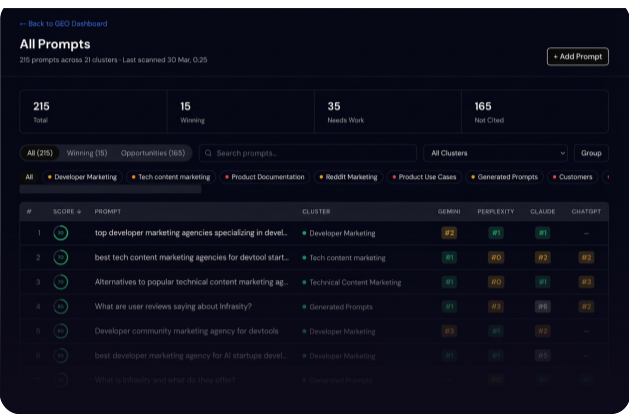


Track and optimize for all major AI platforms


One Platform. Track AI Visibility.
Win More Citations.
Everything you need to understand and grow your AI search presence
Ready to Get Your Product Recommended by AI?
We'll show you where your product stands today and what it takes to get cited across ChatGPT, Claude, and Perplexity.
Frequently Asked Questions
Have a question that needs a human to answer? No problem.
Optimizing for ChatGPT citations requires a different approach than traditional SEO. Start by creating authoritative, well-sourced content that demonstrates clear expertise signals. ChatGPT prioritizes sources that cite their own references and show credible research. Use structured data markup (Schema.org) to help AI models parse your content more effectively.
Keep your content updated regularly, as fresher content gets prioritized in AI responses. Build quality backlinks from authoritative sources in your niche, since AI models still use web authority as a ranking signal. Structure your content to directly answer common questions with an "answer-first" approach rather than burying insights deep in articles. Finally, track what’s working with tools like Infrasity so you can see which content gets cited most often and iterate based on real data rather than assumptions.
Tracking AI visibility requires specialized tools like Infrasity that can run hundreds of relevant queries across multiple AI models simultaneously. These platforms query AI models with prompts relevant to your business, track which models cite your content and how often, monitor competitor citations and share of voice, identify content gaps where you should rank but don’t, and show trends over time as you optimize your content.
Manual tracking by searching for your brand yourself doesn’t scale and typically misses over 90% of the relevant queries where you could be getting cited. Automated tools give you a complete picture of your AI visibility landscape.
AI citation tracking monitors how often AI models like ChatGPT, Claude, Perplexity, and Gemini reference, recommend, or link to your website, product, or content in their responses. It’s essentially the GEO equivalent of rank tracking in traditional SEO.
Tools like Infrasity automate this process by querying AI models with hundreds of custom prompts relevant to your business, then tracking citation frequency, position in responses, and your share of voice compared to competitors. This gives you quantitative data on your AI visibility that would be impossible to gather manually.
AI models prioritize content based on several key factors. Recency plays a major role — recently published or updated content tends to rank higher in AI responses. Authority matters significantly, with AI models favoring content from recognized experts, established brands, and well-linked domains. Relevance to the user’s query intent is crucial, as is content structure. Clear headings, well-organized information, and concise answers tend to perform better than dense walls of text.
AI models also prefer citing diverse sources rather than relying on a single reference, so being one of few authoritative sources on a topic helps. Finally, crawlability matters — content behind paywalls or login walls is less likely to be cited since AI models need easy access to verify and reference the information.
AI visibility scores vary significantly by industry and competitive landscape:
0-20%: Low visibility (most companies start here)
20-40%: Moderate visibility (cited occasionally in relevant queries)
40-60%: Good visibility (competitive in your niche)
60-80%: Strong visibility (market leader positioning)
80-100%: Dominant visibility (rare, typically category creators only)
For context, most B2B SaaS companies start with 5-15% visibility, while developer tools and AI companies average 20-35%. Improving from 10% to 40% visibility typically takes 3-6 months of consistent GEO optimization efforts.
AI ranking happens faster than traditional SEO. New content can be indexed and cited by AI models within 7-14 days. Updates to existing content typically reflect in AI responses within 3-7 days. Backlink impact takes slightly longer, usually 14-30 days for authority signals to propagate through AI models.
For sustained, measurable improvements in citation rates, expect 60-90 days of consistent optimization. This faster timeline exists because AI models update their knowledge bases more frequently than Google updates search rankings, making GEO a more responsive channel than traditional SEO.
Share of voice measures what percentage of AI citations in your category go to your brand versus competitors. For example, if 100 prompts about "developer marketing agencies" are asked across AI models and Infrasity gets cited 11 times while competitors get cited 89 times combined, your share of voice would be 11%.
This metric helps you measure brand dominance in AI-driven conversations and benchmark your performance against competitors. Unlike traditional SEO metrics like keyword rankings, share of voice gives you a clearer picture of how often you’re winning mindshare in the queries that matter to your business.